


We take for granted that play is good for children.
As a society, we generally espouse play as the singular “work” of the young child, and it takes almost no brain cells at all for us to come up with all the reasons play is important and necessary.
And indeed, young children do play in societies all over the world, which tells us there is something universal about the activity.
But over the last hundred years in Western societies, children’s play has been co-opted by adults as opportunities for enriched learning.
I’m writing this in December – the absolute best time of the year for the toy industry. Especially the baby toy industry.
A fresh, precious new baby is a delight to the world. What possibilities are held in this nugget? What genius is waiting to reveal itself?
What opportunities for play must be presented to this new babe in order to help him reach his full potential?
As developmental experts, we are (perhaps unknowingly) co-conspirators with the toy industry. Our posts and recommendations to families are full of the “right” toys to help baby’s development. Think lots of wood, no batteries, and plenty of features that support baby’s learning.
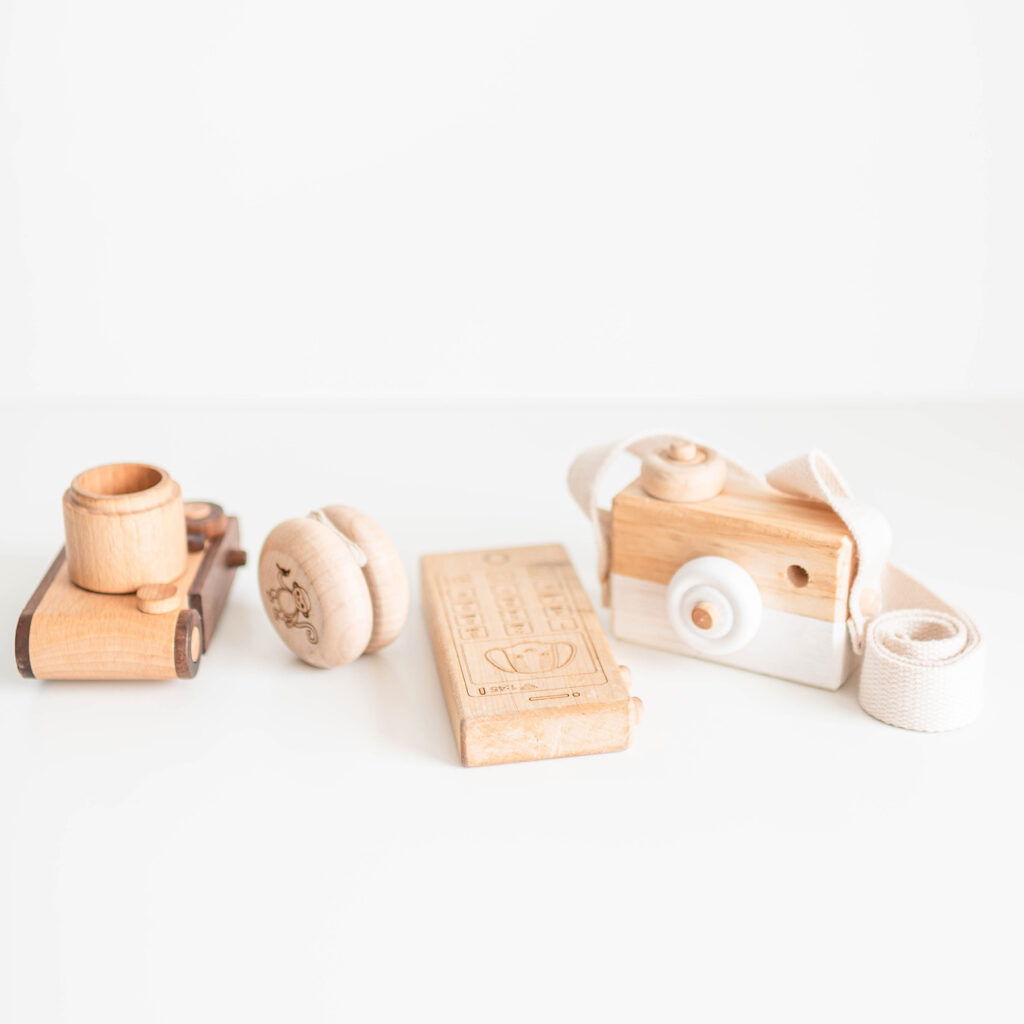
And those toys are CUTE. And sweet, and fun (for us), and we really love them. But baby?
Baby honestly could care less. He’d much rather have mom’s phone she keeps holding, or dad’s game controller, or maybe that crinkly piece of paper.
This December, friends – I suggest we help families lean into what will actually help baby learn. Interacting with faces (free!), and watching and getting involved with the REAL activities parents are involved in.
Babies are humans, and humans are designed from birth to learn how to be human. How do we do that? By watching the other humans around us – and trying to do what they’re doing.
Instead of sticking baby in a corner with an educational toy – let’s put baby smack in the middle of what we’re doing, let them play with the materials we’re working with (yes, of course, as long as they’re safe), and watch their curiosity bloom far greater than any expensive educational toy will allow.
Love learning more about what research has to say about infants, toddlers, and very early child development? Check out the Athenaeum, where I break down current knowledge and thoughts from across research fields, so we can bring a deeper perspective to our own practice.
As I’ll note in each post:
These are not my original ideas, but rather a synthesis of what scholars in a variety of fields have learned and written. I often do not have answers to the tensions I see – my aim is not to be another expert in a field already over-run with them. Instead, I want to shine a light on knowledge we take for granted but shouldn’t.
In each essay I write, I’ll link the relevant sources when possible as well as cite them at the end. I hope you’ll join this conversation.

REFERENCES
Bornstein, M. H., & Lamb, M. E. (Eds.). (2023). Developmental science: An advanced textbook (8th ed.). Routledge.
Fausey, C. M., Jayaraman, S., & Smith, L. B. (2016). From faces to hands: Changing visual input in the first two years. Cognition, 152, 101-107. https://doi.org/10.1016/j.cognition.2016.03.005
Lancy, D. F. (2022). The anthropology of childhood: Cherubs, chattel, changelings (3rd ed.). Cambridge University Press.
Rogoff, B. (2003). The cultural nature of human development. Oxford University Press.




+ show Comments
- Hide Comments
add a comment